
How to End a Power Struggle Without Giving In

Updated: Sep 15
You tell your middle schooler to do something. They push back. You explain. They challenge your explanation, so you explain again, because apparently the first explanation didn’t have enough razzle-dazzle on it.
They get louder. You get louder. Their attitude shows up. Your attitude decides to join the party. And somewhere along the way, what you originally asked them to do isn’t even the issue anymore.
Now you’re arguing about the argument.
And this is where we parents can get stuck, because stopping can feel a whole lot like losing.
If I stop talking, they’re going to think they won.
If I walk away, they’re going to think they got away with it.
I need them to understand why I said what I said.
Friend, I have been completely guilty of this. But there is a distinction that changed the way I started looking at these interactions:
Holding a boundary and continuing a battle are two different things.
You can stop doing one without giving up the other.
More Arguing Doesn't Mean More Resolution
Research on parent-adolescent conflict helps explain why these interactions can escalate so quickly. Conflict can become reciprocal: your child’s emotional response affects yours, yours affects theirs, and pretty soon both people are contributing to what happens next.
In plain language? More arguing does not necessarily create more resolution. In fact, when arguing becomes the groove you fall into over and over again, you can begin shaping your relationship around conflict.
You cannot control whether your middle schooler gets upset, disappointed, rolls their eyes, or wants to argue.
But you can control whether you continue adding to the exchange.
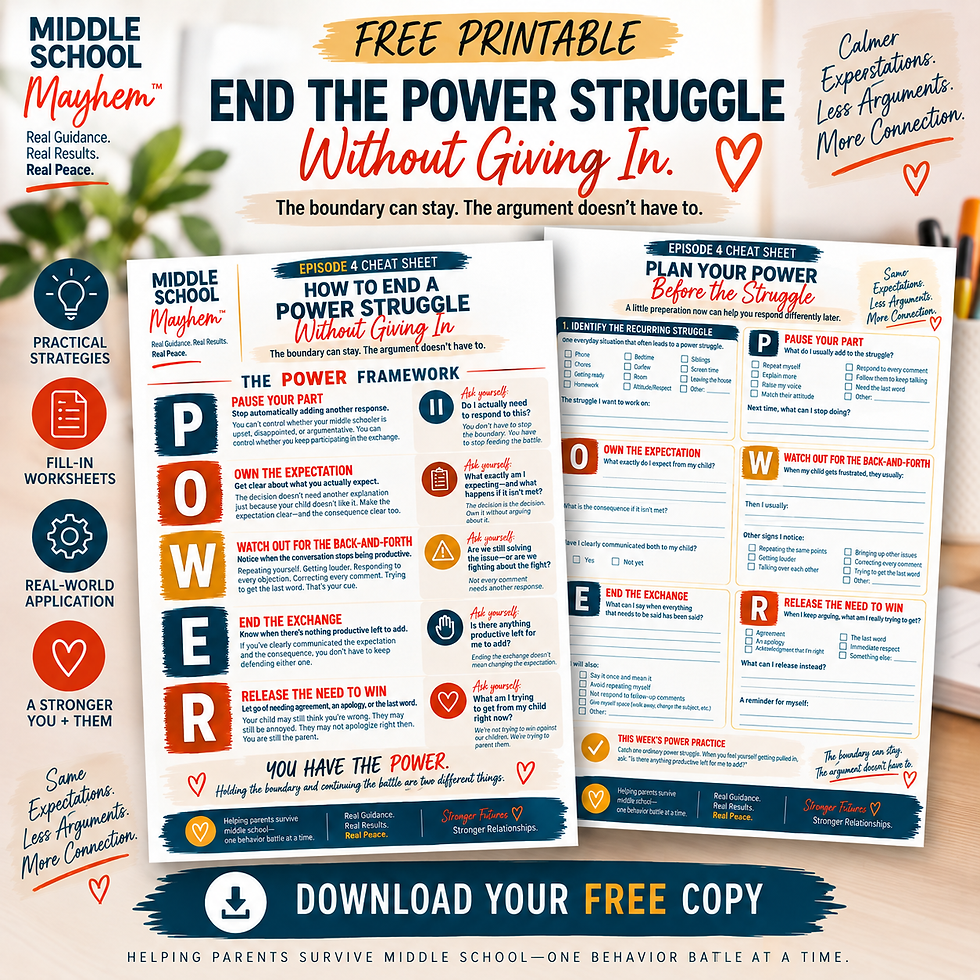
That’s what the POWER Framework is about. POWER isn’t about overpowering your child. It’s about recognizing the power you have over your own participation while still maintaining your expectations and authority.
P- Pause Your Part
Yes, I know.
But THEY'RE the one arguing!
Maybe they are. But if I’m waiting for my child to regulate before I regulate, I’ve handed them control over what I do next.
Pausing your part means you stop automatically responding to every objection, challenge, “but Mom,” eye roll, and dramatic performance that comes your way.
When I first started doing this with my oldest son, he hated it. If he was ready to argue and I suddenly said, “I’m not talking about this anymore. I’ve told you what it is,” I could practically see cartoon steam coming out of his ears.
But I had stopped feeding the exchange.
Ask yourself: Do I actually need to respond to this?
If you’re on Explanation Number Six and nothing new has been said since Explanation Number One, probably not.
O- Own the Expectation
Before the argument started, what did you actually expect?
When my oldest first got a phone and, for the record, I thought we got him one way too early—our expectation was simple: the phone went on the banister at 9:00 p.m.
Sometimes it was under the bed. Sometimes he “forgot.” But the expectation didn’t need a PowerPoint presentation, three witnesses, and Exhibits A through F.
Phone on the banister at nine. And if the phone wasn’t there, there was a consequence.
Eventually, I started clearly stating the expectation and consequence, asking him to repeat them back to me, and then asking, “Do you have any questions about what I expect?”
That small change made a tremendous difference. Now he’s getting ready to graduate high school, and even conversations about things like missing curfew are easier because we aren’t debating what was already established.
The decision is the decision. Own it without arguing about it.
W- Watch Out for the Back-and-Forth
When you change the way you interact, expect some resistance.
Your child is accustomed to the old dance. So when you stop doing your usual steps, they may initially push harder.
Watch for the moment when a productive conversation becomes repeating, getting louder, responding to every correction, defending every point, or trying to get the last word.
Ask yourself:
Are we still addressing the issue or are we arguing about the argument?
That question can tell you when it’s time to move on.
E- End the Exchange
If your child understands the expectation and knows the consequence, there may simply be nothing else to discuss.
Ending the exchange is not: Fine! Whatever! Do what you want!
That’s giving in.
Ending the exchange means recognizing when there is nothing productive left for you to add.
You can stop talking while the boundary stays exactly where you put it. And that distinction can save you an incredible amount of stress.
R- Release the Need to Win
This one might be the hardest. Sometimes we start out addressing behavior and somewhere along the way decide we need this child to acknowledge that Mama is right.
We want agreement. An apology. The last word. Something! Friend, you might be waiting a while.
Your middle schooler may still think your rule is ridiculous. They may tell their friends how unreasonable you are. They may never give you the satisfying conclusion you had imagined.
Your authority is not established by defeating your child in an argument.
Instead ask: Did I remain clear about the expectation without turning this into a contest?
We’re not trying to win against our children. We’re trying to parent them.
And This Is Bigger Than Home
POWER is also something we can teach our children.Sometimes your middle schooler comes home saying, “My teacher kept arguing with me!” Then you hear the whole story and realize your child had approximately 14 opportunities to stop participating in that interaction.
You don’t have to immediately decide whether your child or the teacher was right. Instead, ask, “At what point did you already understand what the adult expected you to do?” Then ask, “What did you do after that?”
Maybe they kept explaining. Maybe they responded to every correction. Maybe they desperately needed that last word.
Helping them recognize their own participation teaches something much bigger than compliance: having something else to say doesn't mean you have to say it right then. If there is a legitimate concern, it can often be addressed appropriately later. And that’s the bigger goal.
As we learn to communicate differently, we’re modeling for our children how to communicate differently too.
So this week, catch one ordinary power struggle—the phone, the room, the dishes, getting ready in the morning and ask yourself: Is there anything productive left for ME to add?
If the expectation is clear, the consequence is clear, and the answer is no?
Friend, you’re finished. The boundary can stay. The argument doesn’t have to.
The POWER Cheat Sheet, companion resource to Episode 4 of Middle School Mayhem™, is available in the Parent Vault to help you map out one of those predictable power struggles before it happens again.


Comments